

































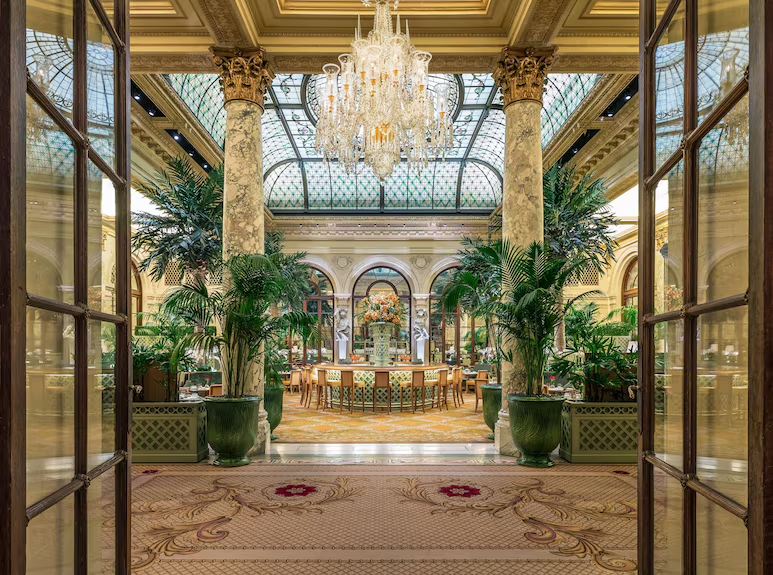
In September 1958, the Miles Davis Sextet took the stage at the Plaza Hotel in Manhattan, New York. The concert was recorded without the musicians’ knowledge and eventually published in 1973 under the title Jazz at the Plaza Vol. 1 (Columbia Records, producer Teo Macero).
You will hear the complete album, consisting of four pieces, followed by two tracks from the best-selling jazz album of all time: Kind of Blue (1959).
Line-up
- Miles Davis – Trumpet
- John Coltrane – Tenor Saxophone
- Cannonball Adderley – Alto Saxophone
- Bill Evans – Piano (Wynton Kelly replaces Evans on one track from Kind of Blue)
- Paul Chambers – Bass
- Jimmy Cobb – Drums
Part 1: Jazz at the Plaza Vol. 1
“The Plaza” is an iconic hotel in New York City with a rich history of famous guests (Enrico Caruso, F. Scott Fitzgerald, Frank Lloyd Wright) and classic film appearances (North by Northwest, Scent of a Woman, Sleepless in Seattle). In September 1958, Columbia Records hosted a party in the Persian Room to celebrate artistic and commercial successes, featuring the Miles Davis Sextet on stage. The accompanying recording tape remained in Columbia’s archives for fifteen years.
- If I Were a Bell: Begins with Bill Evans’ intro on a detuned piano at a record company party. Moments later, the sound of Miles’ muted trumpet fades away, quickly picking up steam musically. Although the audience continues to converse, the sound of the applause suggests appreciation.
- Oleo: A composition by Sonny Rollins that became a jazz standard. A characteristic feature is the instrumentation during the first choruses (AABA structure). It is only with the second soloist that everything really comes alive, pushed hard by drummer Jimmy Cobb.
- My Funny Valentine: Brings a return to calm breathing. The volume drops, requiring listening concentration. Features relaxed tempos, no solos from the two reed players, and superb solo work by Davis and Evans, along with Paul Chambers coloring his bass solo with vocal unison.
- Straight No Chaser: An uptempo piece that, like Oleo, is taken much faster than earlier original versions.
Part 2: Kind of Blue
“One of the greatest albums of all time” – “Davis’ Masterpiece” – “One of the most influential albums ever made” – “The best jazz record of the 20th century” – “A landmark in the evolution of jazz” – “The greatest jazz album ever recorded”
This incomplete list of quotes refers to Kind of Blue (recorded March 2 and April 22, 1959, at Columbia 30th Street Studio, New York City).
Though recorded only a few months after The Plaza with almost the same line-up, there are key differences:
- Repertoire: The Plaza features established repertoire pieces, whereas Kind of Blue consists of brand-new, barely rehearsed compositions.
- Tempo: The Plaza features high-energy tempos, while Kind of Blue stays at a medium tempo or lower.
Selected Tracks:
- Freddie Freeloader (Davis): A blues track featuring pianist Wynton Kelly instead of Bill Evans. Kelly provides a cheerful, rhythmic contrast to the brass section’s long notes. Davis’ solo creates an emotionally charged turning point, complemented by Jimmy Cobb’s modest accentuation.
- So What (Davis): The iconic opening track begins with an ethereal piano/bass intro devised by Gil Evans. It utilizes modal jazz—moving away from traditional chord progressions in favor of two tone series (modes) on D and E-flat. The bass plays the call, while the ensemble responds with the famous two-note “so what” motif.
Links & Broadcasts
- Broadcast 1: Miles Davis & John Coltrane Centennial
- 1st News Item
- Broadcast 2: Miles Davis & John Coltrane Centennial
- 2nd News Item