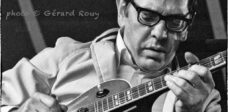
Guitarist Rene Thomas, 1926 – 1975 1/2
March 21st, 2026, 5:00 PM – House of Hard Bop.
At an early age, Belgian guitarist René Thomas was inspired by gypsy guitarist Django Reinhardt, as well as bebop guitarist Jimmy Raney. In Belgium, he regularly played with tenor saxophonist Bobby Jaspar and saxophonist Jacques Pelzer. In the early 1950s, he became a familiar face in the Parisian jazz scene. In 1956, he moved to North America—Bobby Jaspar had already preceded him. In New York, Thomas worked with Sonny Rollins, Miles Davis, and others from the premier league.
Back in Paris (1962), we see Thomas in the company of Chet Baker, Kenny Clarke, and Stan Getz. Fellow musicians were aware of Thomas’s qualities early on. Initially a musician’s musician, he eventually acquired a growing audience. In 1960, Thomas made his recording debut as a leader in New York with the album Guitar Groove (Jazzland label). He had previously worked in recording studios—with Sonny Rollins (Big Brass), among others—but Guitar Groove firmly established his reputation. In the quintet, we hear J.R. Monterose (tenor), Hod O’Brien (piano), Teddy Kotick (bass), and Albert “Tootie” Heath on drums. You will hear the complete album: four standards and three compositions by Monterose.
Variation in the pieces: not only in composition—form, character, tempo—but also in the ‘division of roles’:
Who takes the first solo, Piano sometimes joins in later, then accompanies the guitar solo,
Quartet setup, without sax,
Trio, without sax and piano (and virtually inaudible percussion).
Drummer Albert “Tootie” Heath opens the first piece with an intro solo, gets plenty of room with trading fours/eights, and remains strongly present.
Pianist Hod O’Brien is really doing a lot of filling in the gaps, with his comping behind the soloists…
Spontaneous Effect (JR Monterose)
Ruby my Dear (Thelonious Monk)
Like Someone in Love (Jimmy Van Heusen)
MTC (JR Monterose)
Milestones (Miles Davis)
How Long has This been Going On (George Gershwin)
Green Street Scene (JR Monterose) ——————————————————
Eddy Louiss (1941-2015) started in the 1960s as a singer in Les Double Six – a high-profile vocal group that sang ‘bebop’ in a virtuoso manner. In addition to their close harmony texture, the individual musicians were extremely adept at singing bop improvisations, whether or not accompanied by lyrics articulated at top speed.
But Louiss turned to the Hammond organ, on which he developed his own style compared to the usual suspects on that instrument.
In 1968, Louiss was in Studio Davout in Paris. Beside him were René Thomas and drummer Kenny Clarke. The album Eddy Louiss Trio would not be released until five years later.
Nardis (Miles Davis) The opening, two high organ notes, immediately draws attention. And by the end of the first eight bars—in which the others respond, and drummer Clarke also plays along rhythmically with the theme—we are completely immersed. With the onset of the organ solo, the energy takes a step back, and the focus shifts to the improvisation. The balance between solo and guitar accompaniment is dynamically well-balanced. That balance remains when Thomas takes over the solo. Louiss is also a master of beautiful bass lines! Drummer Clarke, parallel to the organist, gradually moves further forward, culminating in an eight-on-eight, and then a four-on-four dialogue. The now high energy level is maintained in the concluding theme.
Blue Tempo (René Thomas) A long intro, ending in a – also harmonically – ‘search’ for a beginning. Then Clarke sets an up-tempo, and off they go. There is hardly a theme. Thomas is immediately immersed in his improvisation. The modal composition has a 32-measure form: 2 times 8 measures based on a single tone scale. Followed by 8 measures with a different scale, after which the first tone scale returns for 8 measures. (Compositions with a similar form: Impressions by John Coltrane and So What by Miles Davis.) This modal principle creates a different experience than pieces with a song form based on rapid harmonic changes. Don’t miss the transition from guitar solo to organ solo at 3’30”. It seems like a coordinated effort.
“Hard-driving organ jazz,” wrote a critic. And that is exactly what it is.
————————
In June 1970, tenor saxophonist Stan Getz was in Paris with his wife Monica to attend a tennis match. In the evening, Getz stopped by the Blue Note, a club where he had played several times. “I walked in and my mouth fell open.” On stage: organist Eddy Louiss, René Thomas, and drummer Bernard Lubat.
What made Getz’s mouth fall open? You will hear that in the next episode of House of Hard Bop – Eric Ineke