

































Saturday 18th April, 5:00 PM – House of Hard Bop.
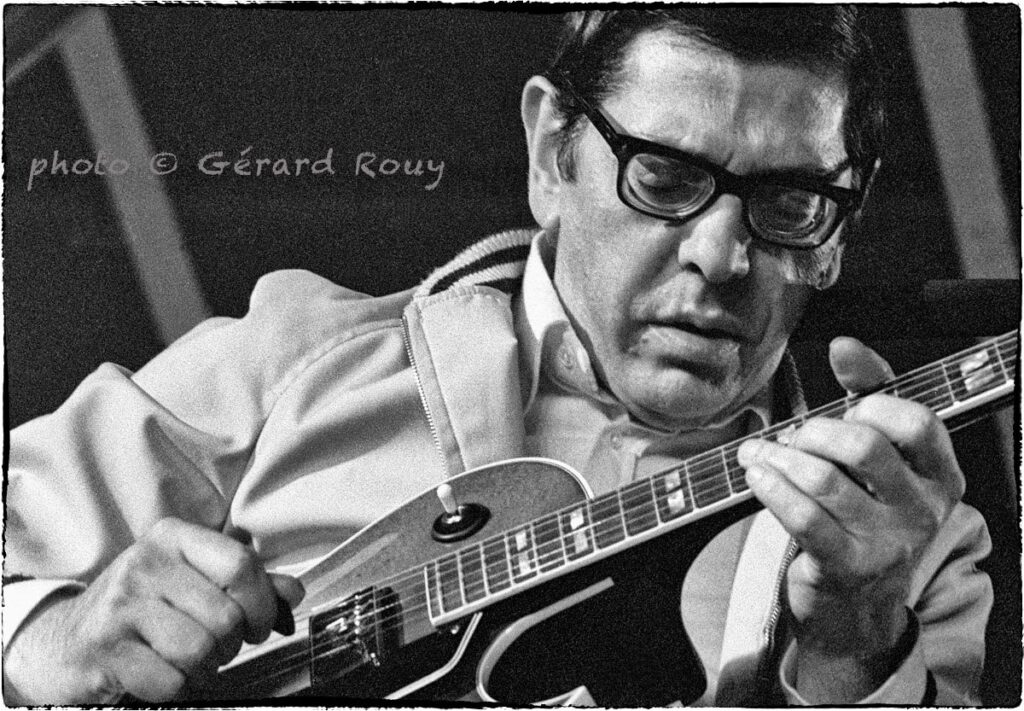
The closing piece—and finale!—of the two-part series*) about guitarist René Thomas takes us to, among other places, Ronnie Scott’s Jazz Club in London. In 1971, Thomas sat on stage there alongside organist Eddy Louiss, drummer Bernard Lubat, and …Stan Getz. This special, high-profile quartet lineup existed for just under a year. Getz wanted to take the group to America, but that fell through due to work permits not being obtained.
The (partly) live album by this group, Stan Getz-Dynasty, was released in 1971 on Verve. The producer was George Martin. (Indeed—the one from the Beatles.)
June 1970. Stan Getz is in Paris to attend a tennis championship. One evening, he walks into the jazz club Blue Note. “I had been told that jazz in France was dead. (…) I walked in and my mouth fell open.” A few months later, back in Paris, he begins rehearsing with the trio that had left him speechless: Eddy Louiss, René Thomas, and Bernard Lubat. In December 1970, the quartet makes its debut at Le Chat Qui Pêche. A long tour follows, including the recording of Dynasty in London.
The three European musicians were an unusual setting for Getz. The same applied to the setlist: virtually all recorded compositions originated in European minds and were new to Getz. Another characteristic of this album is the length of the pieces. Five pieces last longer than ten minutes, with 17’08” as the outlier. ————————————————————
Dum!Dum! (Eddy Louiss) The theme alone is almost a piece in itself. The dynamic shifts between soft and strong; the melodic burst in the sax (in which we recognize The Sound); the exciting interplay of harmonies with the chromatically shifting diminished chords.
The subsequent improvisation section is built up quietly. Drummer Lubat plays a soft bossa nova rhythm and builds up slowly. Getz adheres to the dynamic characteristics of the theme. Organist Louiss takes care of the bass and keeps quiet for the time being. Improvising after Getz, he too maintains the tension of the composition. The drummer and guitarist withdraw completely during a few choruses. Guitarist Thomas joins in halfway through the scheme, improvising smoothly and softly.
The entire quartet flares up one last time in the closing theme.
Ballad for Leo (René) Thomas)
Here too, and right from the free-tempo intro, there are differences in volume. Once in tempo, you wonder: a ballad? And that tempo is doubled after just a few minutes. Who cares—it’s really picking up steam. After Getz, it is guitarist Thomas’s turn. He connects with the speed and dynamics of Getz. Notable: organist Louiss keeps his bass line in, but doesn’t push Thomas on with other sounds. Exceptional for an organist. Thomas takes more time now. The same applies to drummer Lubat. After his drum solo, there is a striking silence of eight seconds—in which applause—after which the intro becomes the closer.
Theme for Emmanuel (René Thomas)
A piece with a different kind of vehicle, now modal. Thomas opens the introduction. After the extended opening, the same fast tempo as the previous piece is set in. There is also an organ solo, followed by more pronounced guitar accompaniment. Organist Louiss also works alone for minutes. Lubat demonstrates just how softly a drummer can solo. His solo flows into the closing intro, which Thomas now introduces an octave lower.
Invitation (Bronislaw Kaper)
Not everyone will immediately recognize this title and accompanying music. Yet it is a standard that has been recorded more than fifty times, and by a remarkably wide range of artists at that: John Coltrane, Caterina Valente, The Four Freshmen, Jaco Pastorius… Kaper’s song was the musical theme in the 1952 film Invitation. His On Green Dolphin Street enjoys wider recognition.
The theme remains rather hidden beneath Thomas’s improvisational lines. It is a guitar/organ duo, with the guitarist in the spotlight. An almost meditative interlude in this album—despite Thomas’s fast figures—with a short duration of four and a half minutes.
Our Kind of Sabi (Eddy Louiss)
Everyone is present again in this extended final piece of over 17 minutes. The last five minutes… a surprisingly moving ending.
House of Hard Bop – Eric Ineke
In May, Eric Ineke is launching a series featuring the complete recordings of the Miles Davis Sextet—with John Coltrane—under the banner of 100 Years of Davis & Coltrane. *)
Click for the 1st broadcast
Click for the accompanying News item