


House of Hard Bop – Saturday 17 October 17:00 CET
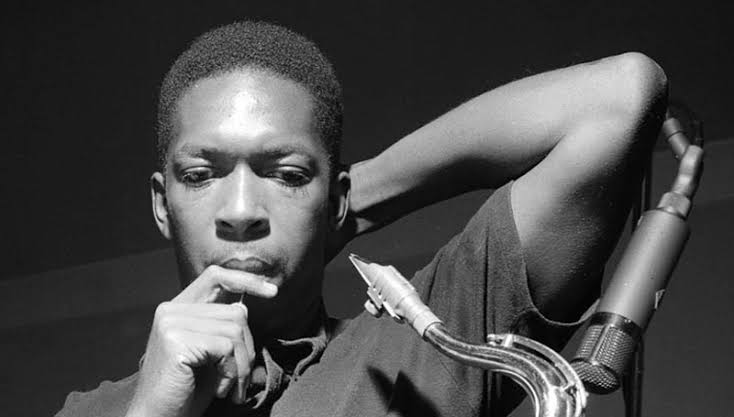
October 1960 was a productive month for saxophonist, composer and bandleader John Coltrane. No fewer than three albums were recorded at Atlantic Records’ New York studio: My Favorite Things, Coltrane Plays the Blues and Coltrane’s Sound. The previous broadcast in this series * already featured some of this material, this programme continues with three tracks from Coltrane Plays the Blues*and six from Coltrane’s Sound.
This was the third recording session for pianist McCoy Tyner with Coltrane and the second for drummer Elvin Jones—the beginning of a long-standing collaboration. Steve Davis played bass, though he was soon succeeded by Reggie Workman, and later by Jimmy Garrison. With Garrison, a quartet was formed that remained together for many years, undergoing a stylistic evolution under Coltrane’s leadership—described by Tyner as “four pistons in an engine”. Garrison remained with Coltrane until the latter’s death in 1967.
Coltrane Plays the Blues
Does an album consisting entirely of instrumental blues actually work? You can hear the variety that it contains in the following three compositions.
- The slow Blues to Elvin (in E-flat) opens with a strikingly traditional piano introduction—a relaxed start to this hour-long set. The same holds true for the solos from both the tenor saxophonist and the pianist.
- Blues to You (in B-flat) takes a different approach. There is no introduction, barely a theme, and a brisk tempo. Here, Coltrane significantly expands his range of expression. Drummer Jones, clearly relishing the tempo, is able to channel his energy; he acts, reacts, and engages in a 4/4 exchange with Coltrane. And what about pianist Tyner? Has he left the studio?
- Things can always be done differently. Mr. Knight begins with the sustained repetition of two bass notes (B), a rhythmic motif spanning two bars. The piece builds gradually, introducing the drums, then the piano, and finally the saxophone. The twelve-bar structure is punctuated by a departure in bars 9 and 10, a pattern that persists throughout. Bassist Davis maintains his two-note rhythmic motif, while drummer Jones sticks to a ‘latin’ accompaniment. Yet, in every instance of bars 9 and 10, the bass shifts into a ‘walking’ line and the drummer varies his pattern.
————————————————–
Coltrane’s Sound
This album is a blend of standards and original compositions by Coltrane. The standards undergo a significant transformation.
- The Night Has a Thousand Eyes (Buddy Bernier/Jarry Brainin) iis a 1948 film song that has been recorded by many musicians. Coltrane puts his own spin on the piece, which features a structural alternation between two distinct sections, each with its own character. There is a compelling, cohesive tension among the four musicians.
- Central Park West (Coltrane) shifts to a lower tempo and reduced intensity with Coltrane playing the soprano saxophone. Like any piece of music, it can be enjoyed without any conscious knowledge of harmony or form. For those interested: the formal structure consists of 10 bars—deviating from the more common 12, 16, or 32-bar patterns. Furthermore, the relationship between the primary harmonic roots is based on thirds—a relatively novel approach in jazz harmony, now closely associated with Coltrane. This is clearly audible in bars 1 to 6, where the bass line makes distinct leaps. From bars 7 to 10, the bass remains on a single note, lending those four bars a ‘meditative’ quality.
(For further explanation, click here for ‘Central Park West’ and here for ‘Coltrane Changes’.)neemt terug in tempo en intensiteit. Coltrane hier op sopraansax. Zoals elk muziekstuk is ook dit te genieten zonder bewustzijn en kennis van harmonie en vorm. Voor de geïnteresseerde: het vormschema bestaat uit 10 maten – afwijkend dus van de veel voorkomende 12, 16, 32, enz. En de relatie tussen de belangrijkste harmonische grondtonen is hier een tertsrelatie. Dat is tamelijk nieuw in de jazzharmonie, verbonden aan de naam Coltrane. In de maten 1 t/m 6 valt dat goed te volgen – de bas maakt sprongen. Die bas blijft daarna hangen op één toon, vanaf maat 7 t/m maat 10. Dat geeft die vier maten iets ‘meditatiefs’.
(For more information: Click here for ‘Central Park West’ and here for ‘Coltrane Changes’.)
- Liberia (Coltrane) is named after the West African country, which was founded as a ‘homeland’ for African Americans. Are you familiar with the piece “A Night in Tunisia”? “Liberia” shares similarities—and not just geographically—with that composition. It features fiery solos from both Coltrane and pianist McCoy Tyner.
- Body and Soul. This highly regarded standard was recorded in 1939 by saxophonist Coleman Hawkins, marking his national breakthrough. The interpretation by Coltrane’s quartet also bears a distinct signature. Several characteristics are revealed as early as the introduction: sustained, repeated bass notes, paired with the repetition of pianist McCoy Tyner’s robust block chords. Also notable is the use of ethereal, “augmented” chords, linked to “whole-tone” figures within the melody.
- Satellite. A trio setting without a piano.
As early as 1957, saxophonist Sonny Rollins began working with a fixed lineup of saxophone, bass, and drums—omitting piano, organ, and guitar entirely. It suited him well. Why not? No percussion? No bass? Consider pianist Oscar Peterson accompanied only by bassist Niels-Henning, or pianist Misha Mengelberg accompanied only by percussionist Han Bennink. Is anything missing?
- 26-2 is said to be based on Charlie Parker’s Confirmation. That may be, though it is not particularly apparent. What we do hear are the relationships between chords based on intervals of a third—the so-called “Coltrane Changes” (see also Central Park West). McCoy Tyner, usually a very active presence, remains silent during the tenor saxophone solo. Following the piano solo, there is a striking moment: the soprano saxophone enters!
And while listening to the tenor solo, pay close attention to Elvin Jones—specifically his accents. Capturing all of them in musical notation would be no easy task. What a drummer!
House of Hard Bop – Eric Ineke
*) John Coltrane Centennial 5 – Click here to listen to the programme and click here for the accompanying news item.
