


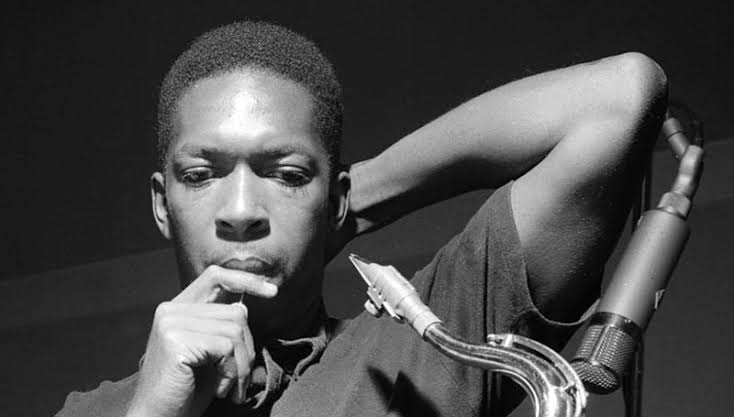
Saturday 21 November, 17:00 CET – House of Hard Bop.
In the previous episode – John Coltrane Centennial (6)* – you heard music from John Coltrane Plays the Blues. Ballads appeared in 1963. This is also a concept album, but this time it is not the form (blues) but the tempo (gentle) that links the pieces. The reception of Ballads was not unanimous. Crescent (1964) is generally considered in the history of jazz to be the predecessor of A Love Supreme that appeared in 1965. That doesn’t give enough credit to the intrinsic value of Crescent.
Line-up: McCoy Tyner piano, Jimmy Garrison bass, Elvin Jones drums.
BALLADS
This album got a fair amount of criticism when it was released. The music was considered to be rather ‘easy,’ and the individual tracks were considered to be short. Was the label, Impulse!, really behind this? Was it an attempt to appease critics who found Coltrane’s music too complex? And was this something Coltrane himself truly wanted? The answers to all these questions is yes. Producer Bob Thiele felt it was time to showcase a more accessible side of Coltrane, and, in doing so, to convince critics that Coltrane was, in fact, well-versed in his musical roots. There was no commercial motive involved. During this same period, the album Duke Ellington & John Coltrane was recorded, and, a year later, a record featuring vocalist Johnny Hartman was released. In this way, Coltrane was exploring musical paths that he himself found meaningful.
The three studio sessions for *Ballads* spanned the course of a year. The sheet music—for pieces that had not been played previously—was reviewed and discussed in the studio, rehearsed for about half an hour, and then recorded. Usually, a single take was enough, though this was not the case for All or Nothing at All.”In terms of tempo, that piece is not a true ballad; furthermore, both its intro and outro are quite long in relation to the track’s total duration of just 3 minutes and 30 seconds.
- Say It (Over and Over Again) – Jimmy McHugh
- You Don’t Know What Love Is – Gene DePaul
- Too Young to Go Steady – Jimmy McHugh
- All or Nothing at All – Arthur Altman
Total duration 17’35”.
CRESCENT
This is the first studio album featuring this lineup, with all tracks composed by Coltrane, the complete opposite to Ballads. A second difference: there are only five tracks, with a total duration of over 40 minutes—a sharp contrast to the compact tracks on Ballads. The atmosphere is melancholic and meditative—with one exception—which, in this case, is the same as with Ballads. Once again, there are no fast tempos. By this time, the level of group cohesion within the quartet is exceptionally high.
Crescent opens in a ‘searching’ manner, with long, sustained notes, before the theme is introduced. Although the slow melody follows a metrical structure, this is not emphasised. The third phase begins with the established tempo and meter—serving as an introduction to Coltrane’s solo. He develops this into a compelling, highly varied discourse, punctuated halfway through by the piano dropping out. The final phase returns to the opening, but significantly extends its duration.
Wise One is similar—surprisingly, perhaps? It is not until three minutes in that the piano trio establishes the definitive tempo, accompanied by a Latin-style drum pattern. Following a brief piano solo played in block chords, Coltrane enters. The formal progression of this piece is identical to that of ‘Crescent’; in terms of structure, form and atmosphere, the two are like twins.
Bessie’s Blues is the third—and central—piece of the five. A fast, swinging blues with a lighthearted, major-key character, set amidst more subdued compositions in minor modes. All this within three and a half minutes. It brings to mind the fourth piece from Ballads. It is another striking departure within the collection as a whole.
Lonnie’s Lament is the saddest piece in the series. A series that is often described in the literature as Coltrane’s “(…) darkest album.” The structure is similar to “Crescent” and “Wise One.” As with those two tracks, the transition into the final tempo and rhythmic section is a particularly striking moment.
There is no tenor saxophone solo; instead, following the exposition of the theme, there is an extensive piano passage, characterised by many bright, two-note intervals within the melodic line. The mounting tension is closely tracked and echoed by drummer Jones.
Then, it is the turn of bassist Jimmy Garrison. His exceptionally long solo—unaccompanied by piano or drums—remains entirely in keeping with the mood of the piece. This is followed by a reprise, which adheres strictly to the established pattern.
The Drum Thing puts drummer Elvin Jones in the spotlight. Following an opening by the drums and bass, Coltrane introduces a melody—soft, in a diatonic minor mode, with a simple rhythm that lacks a strong sense of meter; it is meditative, consisting of a series of long, “dreamy” phrases. The bass remains anchored to a rhythmically repeated low A. Then, it is Jones’s turn. He develops an elaborate narrative on the drums, transitioning from a soft, dark-hued sound—achieved through the use of mallets—to a dynamic, rhythmically fiery intensity, punctuated by the sharper timbre of the snare drum. It is a long, soaring arc of tension. After several minutes, Jones returns to the dark tones of his tom-toms, leading into a reprise of the bass note and the tenor saxophone phrases.
The final word belongs to bassist Garrison. He breaks free from the monotonous A, introducing—quite unexpectedly—a new note three times: an E! (Consider what the effect would have been had that final bass note also been an A.)
House of Hard Bop – Eric Ineke
*) Click here to listen to the previous episode, John Coltrane Centennial (6)
*) Click here for the associated news item
(You might wish that the percussion had been brought a bit more to the fore in the audio mix. After all, you wouldn’t want to miss any of what drummer Elvin Jones is doing, would you?)
