

































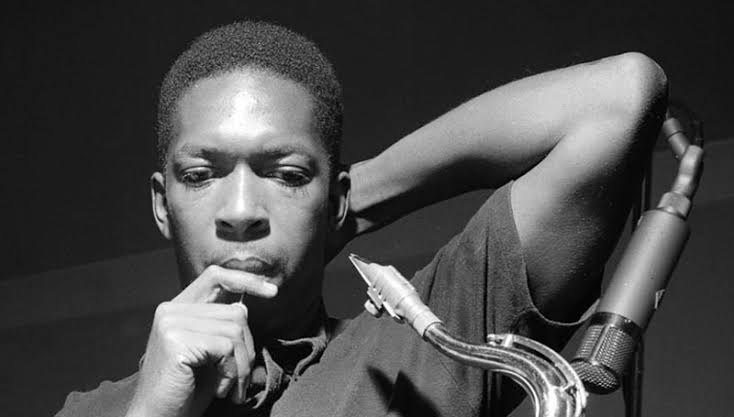
Saturday 20 June 2026, 17:00 CET – House of Hard Bop.
The first episode of this Centennial series* ended with two pieces from the compilation album 1958 Miles. Today, House of Hard Bop continues with Stella by Starlight and Love for Sale from the same album.
After that, all attention is focused on the complete Miles Davis at Newport (1958).
In both recordings, in addition to Davis and Coltrane, we also hear: Cannonball Adderley (alt), Bill Evans (piano), Paul Chambers (bass) and Jimmy Cobb (drums). This was one of Davis’s many influential top line-ups in his stylistically exceptionally rich life.
1958 Miles
Bassist Paul Chambers opens the piano intro of the standard Stella by Starlight with a bowed, sustained note. Davis begins the melody with many pauses (silences). His development of the theme is rich in colour and dynamics. A beautiful moment: Davis hands over the solo baton to Coltrane, where the change of volume, and the transition from brushes to sticks, gives the soundscape a kick. After the short solos by tenor sax and piano, there is a return to the initial atmosphere, but in reverse order: a trumpet solo, followed by piano and then bowed bass to conclude.
In Love for Sale (11’46”), the soloists are given plenty of time. The same goes for pianist Bill Evans.
It again took some getting used to for Evans, just as with Coltrane’s debut in Miles’ band*), Davis to Evans: “Bill, you know what you have to do, don’t you, to be in this band?” He (…) shook his head and said: “No, Miles, what do I have to do?” I said: “(…) You got to fuck the band.” Hm…
Davis: “Bill had this quiet fire that I loved on piano. (…) Crystal notes or sparkling water cascading down from some clear waterfall.” But Evans didn’t have ‘everything’. Sometimes Davis brought back pianist Red Garland for certain pieces. Or Wynton Kelly.
In addition to Evans’s playing style, which Davis found fresh and innovative, Davis was also fascinated by his ideas on ‘modality’. Evans also introduced him to music by Ravel, Rachmaninov and Khachaturian. A whole new world opened up for him. All those possibilities regarding scales and harmonies — far removed from the jazz boundaries of the time.
The collaboration with Evans did not last long. Evans hated touring. In addition, black people often criticized Davis because he had a white boy in his band. Was that really necessary? Evans struggled to handle that as well.
————————————
The Newport Jazz Festival is a multi-day jazz festival held annually in Newport (Rhode Island) since 1954. Miles Davis made his debut there in 1955. His muted solo in Round About Midnight caught the attention of all the festival goers and made a huge impression. This comeback, following a difficult period in his personal life, earned him a record contract with Columbia, as well as a definitive breakthrough in the jazz world.
Three years later, in 1958, he was back on the summer open-air stage with his quintet.
Ah-Leu-Cha
After an introduction by Willis Conover, the quintet opens with Ah-Leu-Cha (Charlie Parker). Here, that standard is given a faster tempo than usual. No objection during the improvisations, but the development of the theme becomes a mess. Breakneck-style rapid swings are also characteristic of the solos by Coltrane and Adderley. Coltrane, in particular, is unstoppable throughout this entire performance in Newport. But they have everything under control!
And then there’s drummer Jimmy Cobb. What energy! That starts right from the theme, where he gets a substantial number of solo bars. And it doesn’t stop there. It remains that way until the very last bar of this entire performance! Sometimes Cobb is seen as ‘not on the same level’ as ‘Philly’ Joe Jones. But he is simply ‘different’. His career received a major boost after the release of the iconic albumKind of Blue 1959 (see the next broadcast). And you, listener, what do you think of his role in Ah-Leu-Cha and the following pieces?
All six pieces of this Newport concert maintain the same high energy level. A real treat!
The Theme is the finishing touch. Davis’s sign-off tune that he used regularly from the 1950s onwards. The often short piece underwent a development over several decades.
————————————–
1958 Miles
- Stella by Starlight (Victor Young)
- Love for Sale (Cole Porter)
Miles Davis at Newport
- Introduction (Willis Connover)
- Ah-Leu-Cha (Charlie Parker)
- Straight no Chaser (Thelonious Monk)
- Fran Dance (Miles Davis)
- Two Bass Hit (John Lewis, Dizzy Gillespie)
- By By Blackbird (Ray Henderson)
- The Theme (Miles Davis)
House of Hard Bop – Eric Ineke
*) Click here to listen to the first episode of the series ‘Miles Davis & John Coltrane Centennial’
Click here for the associated news item.